SAF-T за България: проверете обхвата, сроковете и готовността на данните си
SAF-T не е просто XML файл. Той показва дали счетоводните, данъчните и оперативните данни са съгласувани.
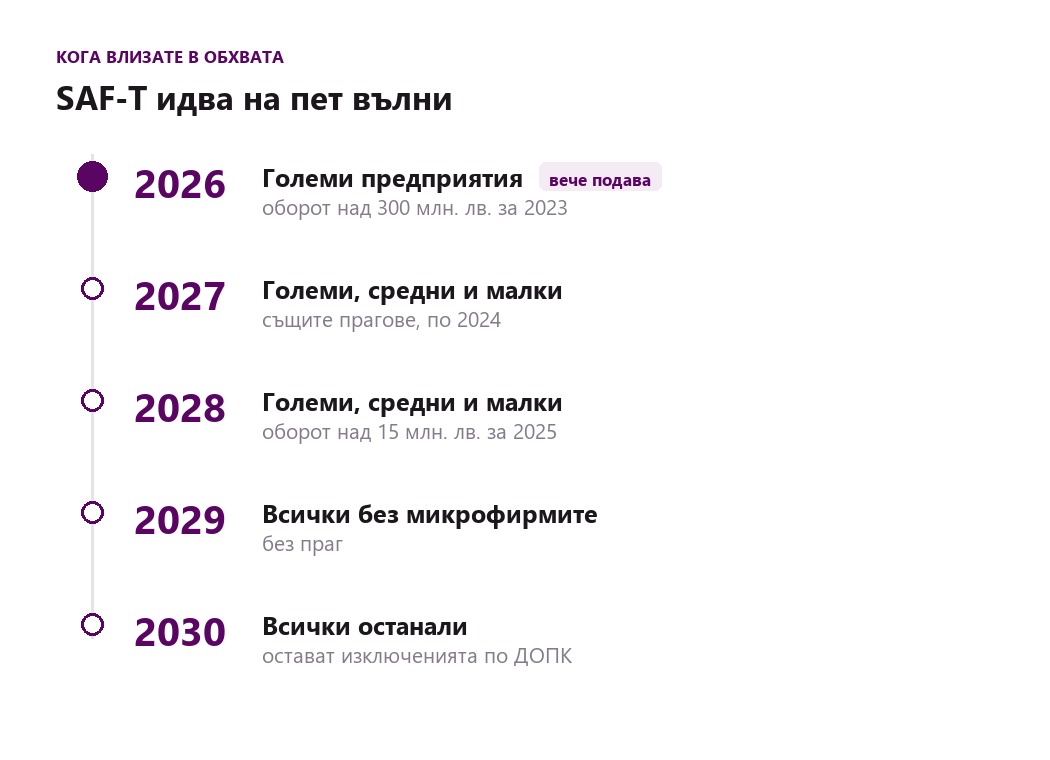
Which year is yours
The obligation arrives in five waves. Each one is measured on a year that has already closed, which means you can tell today whether you are in the next one. The first three waves go by turnover: over 300 M BGN for 2023, the same for 2024, then over 15 M BGN for 2025. From 2029 the threshold disappears and only micro enterprises stay out; from 2030 they follow too. The waves are set out in §17 of the transitional provisions of the Tax and Social Insurance Procedure Code.
One misreading we hear often: being registered with the "Large Taxpayers and Insurers" directorate does not automatically put you in scope, and not being registered there does not keep you out. The scope follows the statutory criteria, not the name of your directorate.
Three rhythms, not one deadline
SAF-T is not an annual chore. Once you are in scope, three different clocks start running at the same time.
Every month
General ledger, invoices and payments, by the end of the following month. The first file covered January 2026 and was due on 2 March, because 28 February was a non-working day.
Once a year
Fixed assets, depreciation and revaluations, within the deadline for the annual corporate tax return under Art. 92 CITA, that is by 30 June.
On request
Inventory and whatever else the NRA asks for, within 14 days of the request.
Two different reliefs, often confused. For the first six months after your start date the NRA will not sanction technical errors. Separately, every monthly file for 2026 that has been submitted and received an entry number, including files returned for errors, can be corrected until the end of February 2027.
What is actually in the file
Around 300 mandatory fields, in XML with UTF-8 and ISO dates, following the OECD SAF-T 2.0 logic with Bulgarian additions. The schema in force is 1.0.2.
Master data
Counterparties with full details, articles, chart of accounts with balances, tax tables, analytical dimensions.
Source documents
Sales and purchase invoices: header, lines and totals.
Payments and ledger
Bank and cash movements, general ledger entries, settlements through the ledger accounts.
Fixed assets
The annual part: acquisitions, depreciation, revaluations, write-offs.
On request
Inventory data, provided only when the NRA explicitly asks.
Where it usually breaks
Not on the XML. On the data underneath it. The file is validated for internal consistency, so a mismatch between two sections is enough for a rejection.
A counterparty without a valid identifier
One supplier entered by name only, and the file is rejected.
Cross-references that do not match
An invoice that does not point at its entry. The file is checked for consistency, not only for shape.
Assets kept in a spreadsheet
The annual section has to come from somewhere. A spreadsheet is not a source.
Data assembled by hand every month
The first file is the expensive one. If it is assembled manually, so is every one after it.
What a missed or wrong file costs. Article 277a of the Tax and Social Insurance Procedure Code provides for a property sanction of 5 000 to 15 000 BGN for companies and sole traders, and double that for a repeated violation within a year. On top sit the ordinary consequences of undeclared data: additional assessments, interest, and a suspended VAT registration.
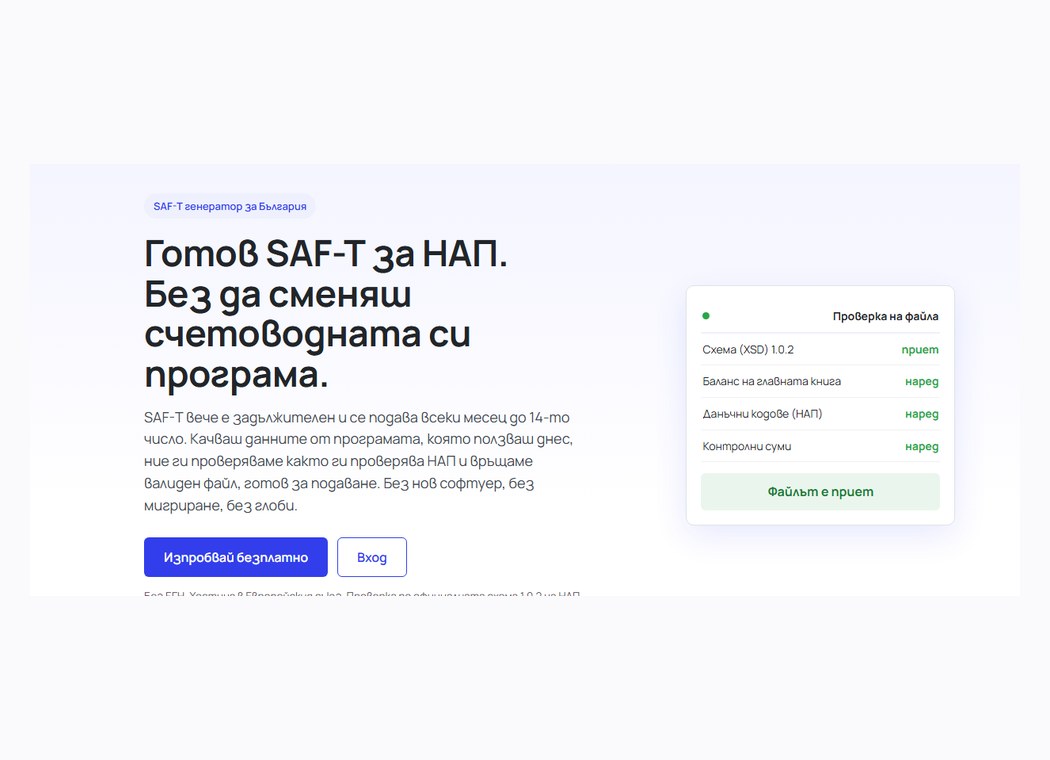
Not on our ERP? The generator does it
If you are not moving your accounting, you do not have to. The generator takes ten filled template tables or a direct export from your current software, runs over 40 checks against the official schema 1.0.2 - balances, control sums, tax codes - and returns an XML ready to upload to the NRA portal.
Предлагаме първоначална проверка на вашите данни и тестово генериране на SAF-T файл без такса при предварително уточнен обхват.
Информацията на тази страница е с общ информационен характер и не представлява данъчен или правен съвет. Обхватът, сроковете и изискванията се определят от действащото законодателство и официалните указания на НАП. Проверете конкретното си задължение с вашия счетоводител или данъчен консултант.